
Science in the South Pole; IceCube Detecting Neutrinos
At a live public general meeting at the University of Adelaide (UoA) hosted jointly by the Astronomical Society of South Australia (ASSA) and the Australian Institute of Physics (AIP), Associate Professor Gary Hill, an Astroparticle Physicist, was the main guest speaker for the event. The ASSA hosts these monthly general meetings at the UoA at 8:00 pm on the first Wednesday of every month, excluding January. May’s general meeting in 2025 involved a compelling topic covering a unique pathway in the space industry. Hill shared his visits to the South Pole and discussed the astronomical results found from the neutrino observations with the IceCube detector.
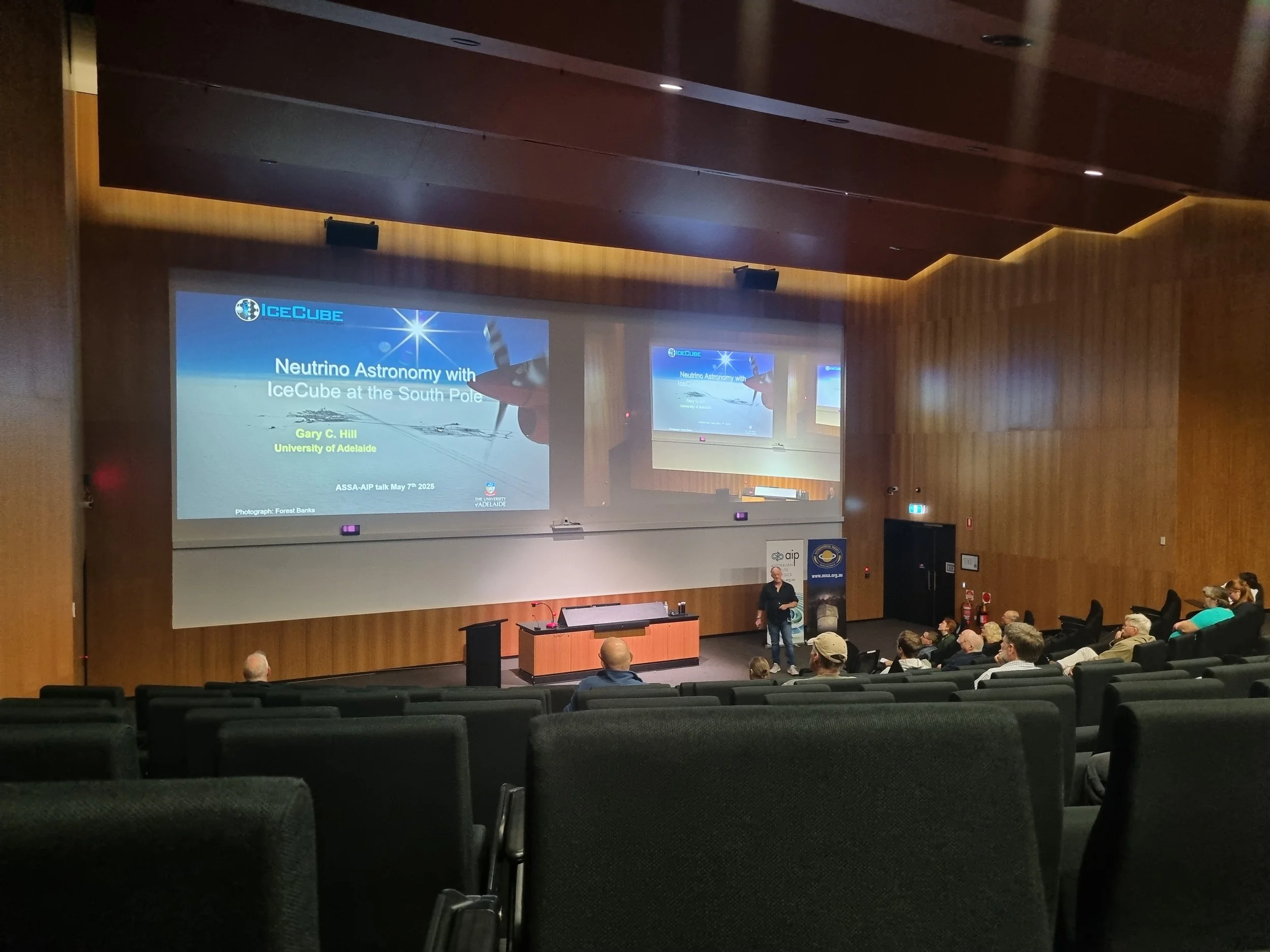
Features Gary Hill, opening his talk at the University of Adelaide on Neutrino Astronomy
As an accomplished astrophysicist and mentor of students, Hill has made significant contributions in the area of high-energy neutrino detection. With a history of 12 visits to the South Pole and an upcoming 13th, he has worked 13 months on the Antarctic Muon and Neutrino Detector Array (AMANDA) and the remainder of his trips on the IceCube detector. With around 30 years of experience in the field and particular research interests in neutrino particles, cosmic rays, gamma rays, and dark matter, Hill has made leading contributions to the world’s largest neutrino detector and shared his time in the field through research papers and public speaking.
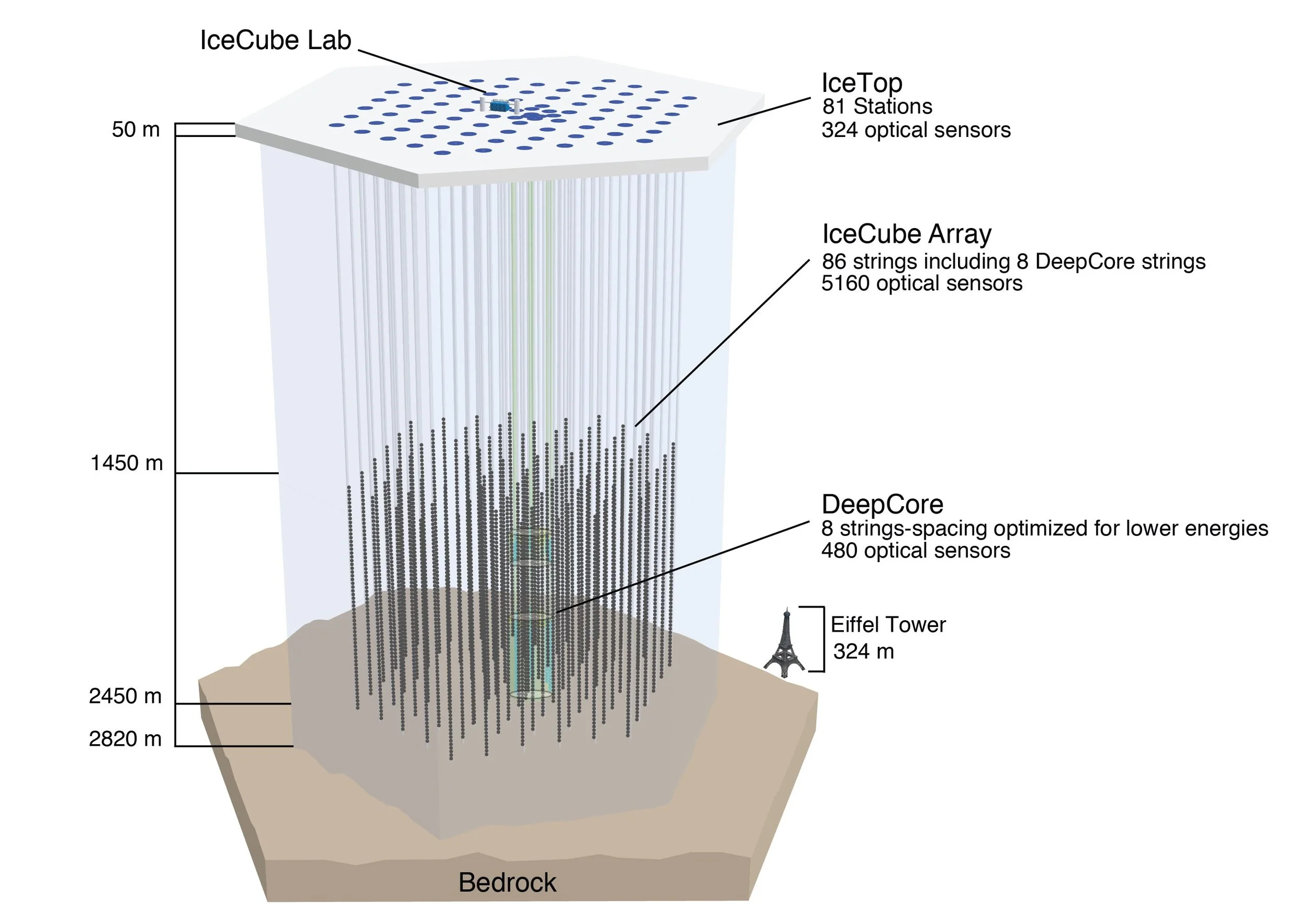
Diagram of IceCube, (IceCube, 2011)
To understand these particles that Hill studies, it’s best to first understand the technology used to observe them. Located at the South Pole, deep beneath the surface lies IceCube, built and frozen into the ice, designed to utilise its surrounding environment as a neutrino detector.
More specifically, IceCube is positioned near the Amundsen-Scott South Pole Station, approximately 2,500m under the Antarctic ice. Embedded in this ice are 86 vertical strings, with 60 Digital Optical Modules (DOMS) attached to each, totalling over 5000. A high pressure hose of hotwater was used to melt these 86 columns that then froze back over after the technology were placed inside. These DOMS have been frozen in place in a particular hexagonal spacing, with the inner strings in tighter to allow the study of neutrino oscillations by lowering the neutrino energy threshold.
Neutrinos are often considered ‘Ghost Particles,’ as however abundant they may be in the universe, they are nearly massless and almost never interact with matter. Almost is the key, as the rare times they do interact are the times we attempt to detect with sensitive underground technology such as IceCube.
IceCube identifies the electrically charged particles, which are byproducts of neutrino collisions. These secondary particles have a measurable signal when interacting within a clear medium, such as the South Pole ice, and examining data collected from these helps us to understand the vast fundamental structure of the universe. In particular, we are able to estimate the astronomical sources that these neutrinos are originating from via the amount of light and the type of pattern produced.
Stepping in further on the measurements, IceCube is mostly examining the neutrinos coming up through the Earth even though it can still observe neutrinos above Earth, the aim is to rid of atmospheric neutrinos by focusing on the neutrinos that are bright enough to stand out on a map as a bright spot (hotspot).
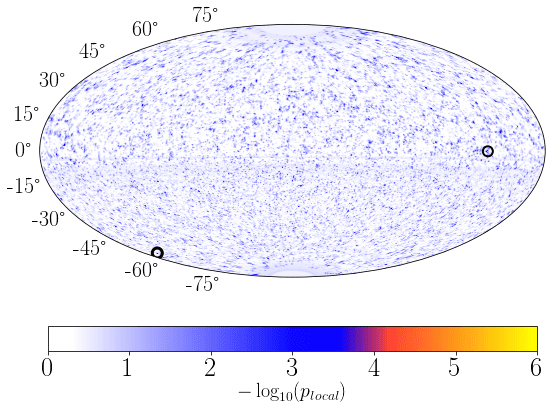
Skymap with Northern and Southern Hemisphere hotspots highlighted via the black circles (IceCube, 2019).
Diving into Gary’s experience of his work, he reminisced on the early ideas about handling the detectors data, which didn’t come about during a lab or a meeting but rather over a casual conversation.
“The idea of rough data came over a dinner table conversation”
This ‘rough data’ being referred to is the initial unfiltered signals recorded by the IceCube detector before they are made sense of and traced back to their source.
Hill’s career illustrates that the space field is not a single, linear pathway confined to laboratories or traditional telescopes. Rather, it can take you to some of the most extreme environments right here on Earth, where groundbreaking studies can contribute directly to our understanding of the universe’s most fundamental processes.
-
IceCube. (2011). Detector. [online] Available at: https://icecube.wisc.edu/gallery/detector/#modulagallery-7032-9784 [Accessed 16 Feb. 2026].
IceCube. (2019). New all-sky search reveals potential neutrino sources. [online] Available at: https://icecube.wisc.edu/news/research/2019/10/new-all-sky-search-reveals-potential-neutrino-sources/ [Accessed 15 Feb. 2026].